
Relationship memory
Saved context about the people in your life and when Perisclaw brings it back.
WhatsApp and email are a constant stream of small updates about the people in your life. A colleague mentions a new role, a friend says they had a baby, a relative is moving cities. These land scattered across dozens of conversations and are easy to lose track of. They matter most the next time you see or speak to that person, which is usually exactly when the detail has slipped your mind.
Relationship memory fixes that. Perisclaw notices what's happening in people's lives and brings it back to you right when you need it.
What Perisclaw keeps track of
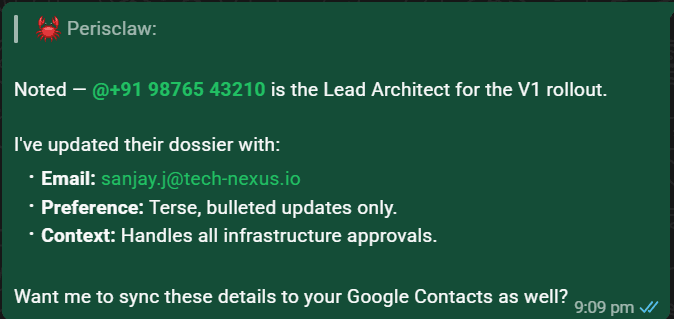
- It picks up life updates automatically, across your chats and email. When a colleague mentions a new role or a friend mentions a baby, Perisclaw records it against that person. You never have to log anything.
- It keeps each contact's details current (role, company, email, birthday), pulled from your conversations and kept in their profile.
- It remembers how you deal with each person: who prefers a text over a voice note, who not to call after 6.
- It syncs both ways with your Google Contacts. Details it learns (email, role, company) get pushed up to your address book, and it can pull your existing contacts down so it starts out knowing who everyone is instead of learning from scratch. Say "import my Google contacts" once and it has the whole address book to work from.
Where this shows up
Relationship memory works on its own, so most of the time you don't have to ask for it. When you have someone coming up in your day, the context shows up in your digests: who you're meeting, and what's new with them since you last spoke.
- "You're seeing Maya at 4. She just started a new job."
- "Dinner with AJ tomorrow. He had a baby last month, you might want to wish him."
Ask any time
You can also pull up what Perisclaw knows, or add and correct details, whenever you like:
- "What do we know about @contact?"
- "Add sarah@example.com to @contact's profile."
- "Remember AJ had a baby last month."
- "@contact prefers texts over calls. Don't ring them after 6."